
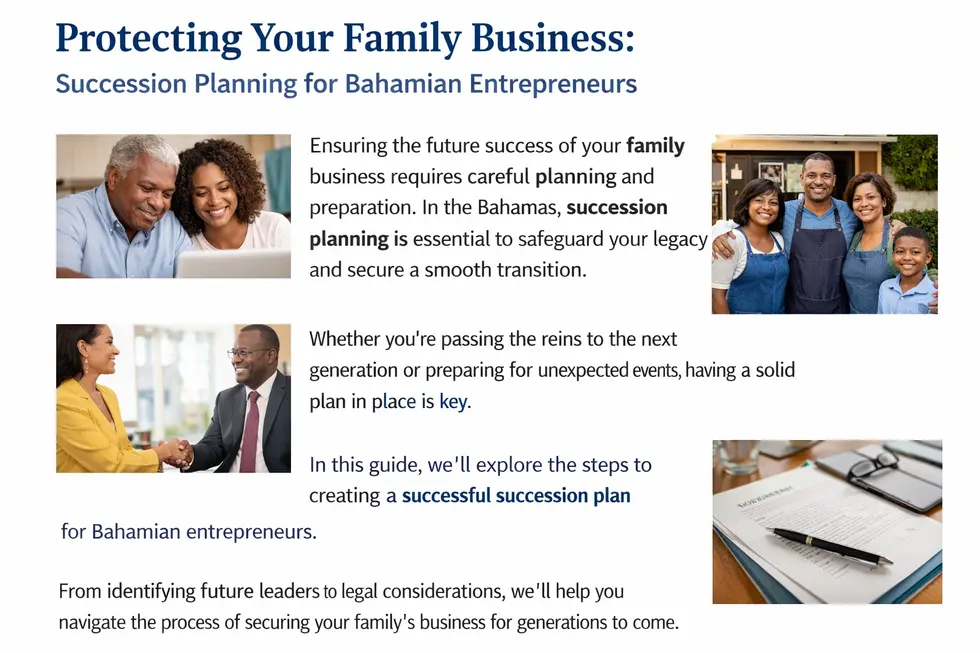
What happens to your business when you are no longer at the helm? For many Bahamian entrepreneurs, the business is more than just an income stream; it is a legacy, a source of community pride, and the primary vehicle for family wealth. Yet, a startling number of family-owned enterprises in The Bahamas do not survive the transition from the founding generation to the next.
The primary reason for this failure is rarely a lack of profit or market share. Instead, it is a lack of structured succession planning that bridges the gap between business law and estate planning. Without a roadmap, the sudden loss of a founder can trigger internal power struggles, frozen bank accounts, and costly litigation that can dismantle decades of hard work in a matter of months.
At Gonsalves-Sabola Chambers, we understand that protecting your family business requires more than just a standard Will. It requires a sophisticated integration of corporate governance and wealth preservation strategies tailored to the unique legal landscape of The Bahamas.
The Foundation: Corporate Governance and Shareholder Agreements
First, you must look at how your business is legally structured. Most Bahamian businesses operate as International Business Companies (IBCs) or through local companies incorporated under the Companies Act. While these structures provide limited liability, they do not automatically ensure a smooth transition of power.

A common pitfall occurs when a founder holds the majority of shares personally. Upon their passing, those shares become part of the estate and are subject to the probate process. During this time, the business may find itself in a state of paralysis, unable to make critical executive decisions or access corporate credit lines.
To mitigate this, entrepreneurs should prioritize a comprehensive Shareholder Agreement. This document acts as the "constitution" of your business ownership. It should clearly outline:
- Buy-Sell Provisions: What happens if a shareholder wants to exit, becomes disabled, or passes away?
- Valuation Methods: How will the business be valued to ensure fair compensation for heirs who are not involved in daily operations?
- Transfer Restrictions: Who is allowed to own shares? Can shares be transferred to non-family members or ex-spouses?
By addressing minority shareholder disputes and governance before a crisis occurs, you protect the operational integrity of the company.
Second: Utilizing Bahamian Trusts for Business Continuity
One of the most powerful tools available to Bahamian entrepreneurs is the use of a Trust. In The Bahamas, the legal framework for trusts is among the most robust in the world. By transferring your company shares into a Trust, you effectively remove them from your personal estate, meaning they are not subject to the delays and public scrutiny of probate.
The Bahamas has abolished the Rule Against Perpetuities for trusts created after 2011, meaning a family trust can now exist indefinitely. This allows for "dynasty planning," where the business remains under the umbrella of the trust for multiple generations.
Key benefits of using a Trust for your business include:
- Avoidance of Probate: The Trust continues to own the shares regardless of the founder's status, ensuring that the Board of Directors can continue to operate without interruption.
- Asset Protection: Bahamian law provides strong protection against creditors, provided the trust was not established with the intent to defraud. This safeguards the business from personal liabilities of the family members.
- Forced Heirship Protection: Bahamian courts do not recognize foreign forced-heirship claims, ensuring that your specific wishes regarding who runs the business are respected.
For high-net-worth families, a Private Trust Company (PTC) may be the ideal solution. A PTC allows the family to retain a level of control over the administration of the trust, acting as the trustee rather than handing total control to a third-party institutional trustee.
Third: Implementing Family Governance Structures

Succession planning is as much about people as it is about law. The "human element": sibling rivalries, differing levels of commitment to the business, and communication breakdowns: is often what leads to the courtroom.
We recommend establishing a Family Council. This is a formal body, usually consisting of 3 to 5 representative family members, that meets regularly to discuss the business's direction and the family's involvement. The Council serves as a bridge between the family and the Board of Directors. It allows for:
- Conflict Resolution: Addressing grievances in a structured environment rather than in the office.
- Education: Ensuring that the next generation understands how the business generates wealth and the responsibilities that come with ownership.
- Governance: Setting clear policies on "Family Employment": defining exactly what qualifications a family member must have to hold a management position in the company.
Transparency through a Family Council reduces the likelihood of future dispute resolution needs and ensures that everyone, whether they work in the business or are simply a silent shareholder, feels their interests are being considered.
Protecting the "Generational Property" and Real Estate Assets
In The Bahamas, business and real estate are often inextricably linked. Many family businesses own the land and buildings from which they operate. However, "generational property": land passed down without clear titles or through intestacy: can become a significant legal hurdle for a growing business.

Recent and upcoming land reform matters in The Bahamas emphasize the need for entrepreneurs to ensure their real estate holdings are properly titled and integrated into their estate plan. If your business operates on land that is still in your great-grandfather's name, you are building on a foundation of sand. Part of your estate planning guidelines must include regularizing land titles to ensure that these assets can be used as collateral or transferred safely to the next generation.
Fourth: Planning for the "Equal vs. Equitable" Dilemma
A major challenge for entrepreneurs is deciding how to distribute the business among children when some work in the business and others do not. Giving everyone an equal share of voting stock often leads to a deadlock, where the child running the business feels hampered by the siblings who only want dividends.
Practical solutions include:
- Voting vs. Non-Voting Shares: Giving the "active" child the voting shares to control the company's daily operations while giving "passive" children non-voting shares that provide a share of the profits.
- Equalizing with Other Assets: Using life insurance policies or other real estate holdings to provide for children not involved in the business, while the business itself goes to the child most capable of leading it.
Taking the Next Step Toward Continuity
Succession planning is not a one-time event; it is a process that evolves as your business grows and your family dynamics change. Waiting until you are ready to retire is often too late. The most effective plans are those established when the founder is still active and can mentor their successors.
At Gonsalves-Sabola Chambers, we combine our expertise in wills, estates, and trusts with a deep understanding of Bahamian corporate law to help you build a fortress around your legacy. We work with you to identify potential risks, draft the necessary legal instruments, and facilitate the difficult conversations that ensure your business thrives for generations to come.
Do not leave the future of your life's work to chance or the complexities of the intestacy laws. Secure your legacy today.
Contact Gonsalves-Sabola Chambers to schedule a consultation regarding your business succession and estate planning needs.

Comments
There are no comments for this post. Be the first and Add your Comment below.
Leave a Comment